PM Modi in Sweden: Strategic Partnership, FTA push and a pitch to double trade in five years
India and Sweden announced a five-year roadmap covering trade, defence, AI, space, startups, mobility and sustainability during Modi’s Gothenburg visit.
Ahead of the visit of the President, and all European Union Commissioners, to India in February 2025, the Economist ran a leader “How India became an unexpected role model for Europe,” that compared India favourably with the European Union (EU), which according to the Economist, had a ‘sclerotic economy’ and ‘gridlocked politics.’




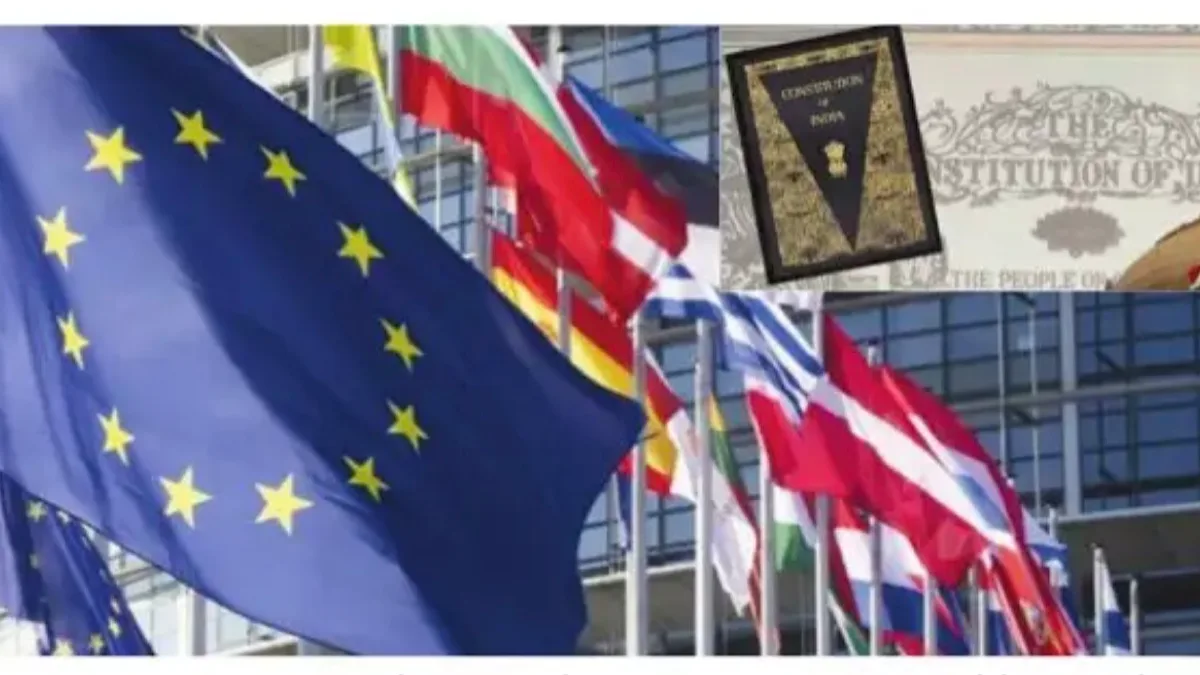
Photo:SNS
Ahead of the visit of the President, and all European Union Commissioners, to India in February 2025, the Economist ran a leader “How India became an unexpected role model for Europe,” that compared India favourably with the European Union (EU), which according to the Economist, had a ‘sclerotic economy’ and ‘gridlocked politics.’ There are, indeed, a number of similarities between EU and India: both are polyphonic and pluralist democracies, both are the antithesis of the modern nation state, which requires a common religion, a common language and a common enemy.
While India has twenty-eight States, EU comprises twenty-seven countries. Both have a common currency, a common flag and a national anthem ~ but the feeling of nationhood is missing in the EU. Also, like the EU, there are vast differences in income and productivity amongst Indian States. And much like the EU, inefficient regions of the Indian Union, are heavily subsidized by hard-working States, courtesy the Finance Commission. As an aside, both Pakistan and Bangladesh are perfect examples of a modern nation state with a common religion (Islam), common language (Bangla and Urdu, respectively) and a common enemy (India), but both are on the verge of becoming failed states, while India and the EU are commendable success stories.
Advertisement
There is no denying the fact that diverse countries and groups, including Russia, China and EU, are cosying up to India, and vice-versa, because of the upheaval in international relations, caused by US President Trump’s erratic activities. The US has all but rewritten her relations with Europe, by excluding Ukraine and all of Europe, in talks between the US and Russia in Riyadh in February, and later accentuating the divide by threatening to levy thirty per cent tariff on EU goods ~ an issue that was sorted out with difficulty. Therefore, copious praise for our governance and institutions by Western media should be taken with a pinch of salt; it may be an atonement for decades of sarcastic, and sometimes even untrue reporting ~ as Virgil had said much earlier, ‘beware of the Greek bearing gifts.’ There is, of course a distinct disadvantage that India suffers vis-à-vis the EU; while Europe is perceptibly divided amongst different nations, divisions in India are not so apparent but often much deeper.
Advertisement
Also, EU members enjoy good bonhomie – even amongst those countries which were on opposite sides during the World Wars. A division assiduously promoted by the political class in India, is the North-South divide, of which language chauvinism is an integral part. Southern states have a long-standing grudge against Northern states, because successive Finance Commissions have allocated funds according to a State’s population, which worked to the disadvantage of southern States, because following Government policy, they controlled their population. Again, because of lower population, the proposed delimitation of electoral constituencies, would add Lok Sabha seats to northern states, while southern states will send fewer MPs to the Lok Sabha.
Then there is the eternal simmering problem of Hindi vs. southern languages, which is not a problem at all, because all languages can grow and flourish together, but sagacity and tolerance are required from politicians to halt what is turning into a virtual language war. Then, India has highly visible economic divisions; we have an uber rich class, a very small middle class, and eighty crore people on free rations. Gross inequality is there for everyone to see ~ every city has skyscrapers housing the rich, and the poor living on the roads next to them. According to the M3M Hurun India Rich List 2025, India has 358 dollar-billionaires, i.e., individuals having wealth of more than Rs.9,000 crore, and 1,687 individuals, with a worth exceeding Rs.1,000 crore.
The number of billionaires has increased six-fold since 2012, and India added 24 billionaires in 2024 alone. According to Oxfam: “The top 10 per cent of the Indian population holds 77 per cent of the total national wealth. 73 per cent of the wealth generated in 2017 went to the richest 1 per cent, while 670 million Indians who comprise the poorest half of the population saw only a 1 per cent increase in their wealth.” There is, of course, a counterview; according to a recent World Bank report, with a Gini coefficient of 25.5, India was the fourth most equal country in the world. According to experts, the World Bank report was based on consumption, and not income data, which masks inequality, to some extent.
Significantly, India’s national account statistics, have been rated at ‘C,’ by the International Monetary Fund (IMF), which concluded that data provided to them had “some shortcomings that somewhat hamper surveillance.” Also, Chancel and Piketty have observed, in the World Inequality Report 2022: “Over the past three years, the quality of inequality data released by the government has seriously deteriorated, making it particularly difficult to assess recent inequality changes.” One reason for this divergence in perception could be that most economies are even more unequal; the disparity between the wealth of the rich and poor is such that the combined wealth of the world’s 10 richest men is more than the wealth of the poorest 3.1 billion people i.e., 40 per cent of the world’s population.
The 10 richest men have so much wealth that if they spent a million dollars each a day, it would take them 414 years to spend their combined wealth, and if they sat on top of their combined wealth, piled up in US dollar bills, they would reach almost halfway to the moon. Then there are concerns about freedom of religion, which is a Fundamental Right, guaranteed by the Constitution. A Pew Research Centre Survey, conducted in 2019-20, found that Indians of all religious backgrounds overwhelmingly felt that they were very free to practice their faiths. Across all major religious groups, most people said that it was very important to respect all religions to be “truly Indian.”
The Survey also found that there were many shared values, accompanied by a number of common beliefs across religious lines. However, such syncretic traditions are increasingly under threat from vote-bank politics, with political parties trying to consolidate votes by appeals to religion, and by propagating a concept of cultural nationalism, and perceived historical wrongs. Such views, once limited to the fringes, are now increasingly becoming mainstream, through right-wing espousal. The US Commission on International Religious Freedom (USCIRF) observed that the present government had “allowed violence against minorities, and their houses of worship to continue with impunity, and also engaged in and tolerated hate speech, and incitement to violence.”
The Commission has consistently recommended that India be labelled a “country of particular concern” which denotes the lowest level of religious freedom. These views have been emphatically repudiated by the Government, but moderate voices are now needed to restore calm in a society, which is being thoughtlessly provoked by age-old fears and anxieties. Caste conflicts often erupt in violent agitations by various castes, for various reasons, mainly job reservation, and demands for a caste-based census, and its acceptance by the Government, has generated a lot of controversy. Complexity of caste-based divisions in India could be understood by the fact that the four main castes in Hindus are further divided into about 3,000 castes and 25,000 sub-castes. Our Constitution bans discrimination on the basis of caste, but sadly, even seventy-five years after Independence, caste is a decisive factor in elections, and Government employment.
The fact that most successful regional parties are caste-based says a lot about the importance of caste in politics. Probably, the caste system, which divides Hindus into rigid categories, is the biggest obstacle to India’s embrace of modernity. Dr Bhimrao Ambedkar, the architect of our Constitution, foresaw the consequences of such divisions in society. He wrote: “On the 26th of January 1950, we are going to enter into a life of contradictions. In politics we will have equality and in social and economic life we will have inequality. In politics we will be recognizing the principle of one man one vote and one vote one value. In our social and economic life, we shall, by reason of our social and economic structure, continue to deny the principle of one man one value…We must remove this contradiction at the earliest possible moment or else those who suffer from inequality will blow up the structure of political democracy which this Assembly has so laboriously built up”.
(The writer is a retired Principal Chief Commissioner of Income-Tax)
Advertisement